

Most compliance failures do not occur because organizations lack policies. They occur because compliance activities are not executed consistently. A review is assigned but never completed. An approval remains pending. Evidence is not submitted. A remediation action stays open for months. Everyone assumes the task is progressing, but nobody has clear visibility into its actual status. This is one of the biggest challenges facing compliance teams today. The issue is not documentation. The issue is accountability. As organizations grow, relying on emails, spreadsheets, and manual follow-ups becomes increasingly difficult. Compliance obligations multiply, departments become more interconnected, and tracking responsibilities becomes...

Most compliance failures do not occur because organizations lack policies.
They occur because compliance activities are not executed consistently.
A review is assigned but never completed. An approval remains pending. Evidence is not submitted. A remediation action stays open for months. Everyone assumes the task is progressing, but nobody has clear visibility into its actual status.
This is one of the biggest challenges facing compliance teams today.
The issue is not documentation.
The issue is accountability.
As organizations grow, relying on emails, spreadsheets, and manual follow-ups becomes increasingly difficult. Compliance obligations multiply, departments become more interconnected, and tracking responsibilities becomes more complex. Without a structured process, important activities can easily fall through the cracks.
This is where workflow automation creates significant value.
The Accountability Bottleneck
Most compliance processes involve multiple stakeholders.
A compliance review may require input from operations, risk, legal, finance, and management. While collaboration is necessary, it often creates a problem.
Responsibility is shared.
Accountability becomes unclear.
When ownership is not visible, progress slows. Compliance teams spend their time chasing updates, sending reminders, and following up on overdue actions.
This creates what we call the Accountability Bottleneck.
Work gets delayed not because people are unwilling to complete it, but because there is no structured process ensuring that tasks move from one stage to the next.
Why Manual Compliance Processes Break Down
Manual compliance management works reasonably well when obligations are limited.
As organizations expand, the weaknesses become more obvious.
- Tasks are tracked in spreadsheets.
- Updates are shared through email.
- Evidence is stored across multiple locations.
- Approvals depend on manual follow-up.
- Leadership receives periodic updates but lacks real-time visibility.
Eventually, the compliance team becomes the workflow engine for the entire process.
This is inefficient and difficult to scale.
More importantly, it increases the likelihood of missed obligations and delayed actions.
The Compliance Workflow Model
Every effective compliance process follows four basic stages.
Assign
A task is assigned to a specific owner with a defined deadline.
Execute
The responsible individual completes the required activity.
Verify
Evidence is reviewed and validated.
Monitor
Progress is tracked and unresolved issues are escalated when necessary.
When any of these stages are managed manually, execution becomes inconsistent.
Workflow automation ensures that each stage is completed in a structured and repeatable manner.
How Workflow Automation Improves Accountability
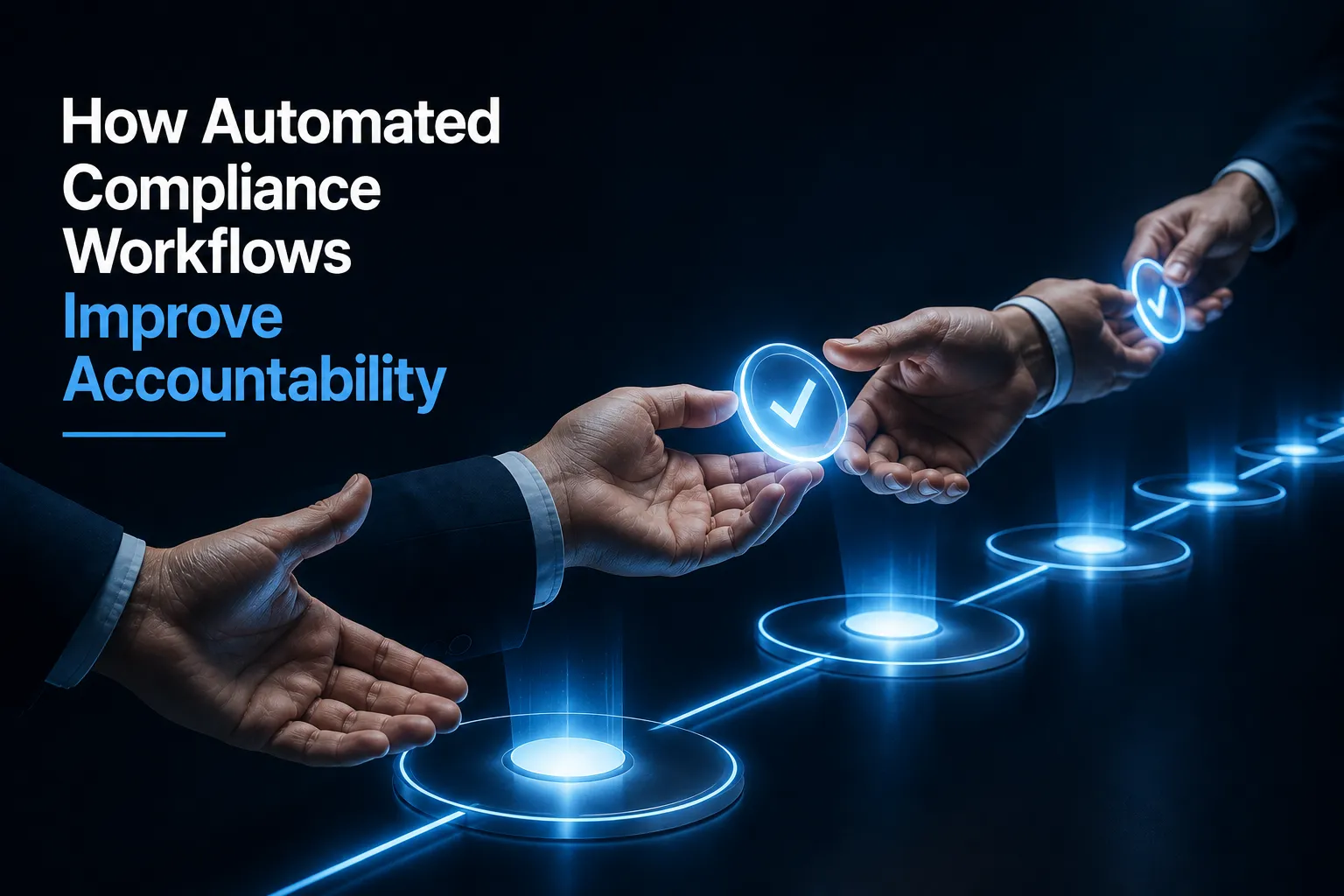
Compliance Workflow Automation Software creates accountability by making ownership visible.
- Every task has an owner.
- Every deadline is tracked.
- Every action is recorded.
- Every overdue activity can be escalated automatically.
Instead of relying on memory or manual reminders, organizations create a system where accountability is built directly into the process.
This significantly reduces execution risk and improves compliance performance.
The Shift Toward Compliance Execution
Leading organizations are moving beyond policy management and focusing on compliance execution.
The key question is no longer whether requirements are documented.
The key question is whether obligations are being completed consistently across the organization.
This shift is driving demand for Compliance Workflow Management Systems and Compliance Execution Software that provide visibility into ownership, progress, and completion.
Organizations increasingly recognize that strong governance depends on strong execution.
How DiskusFlow Helps
DiskusFlow helps organizations transform compliance obligations into structured workflows with clear ownership, accountability, and visibility.
As a Compliance Workflow Automation Software and Compliance Execution Software platform, DiskusFlow enables organizations to assign responsibilities, track progress, monitor overdue activities, and maintain oversight from a single environment.
This allows compliance teams to spend less time chasing updates and more time managing risk.
Conclusion
Accountability is the foundation of effective compliance.
Without accountability, even the strongest policies struggle to deliver results. As compliance obligations continue to grow, organizations need processes that ensure activities are assigned, executed, verified, and monitored consistently.
Workflow automation helps organizations move beyond manual coordination and create a more structured approach to compliance execution.
Because when accountability becomes part of the process, compliance becomes far easier to manage.
Share this article on


