

Corporate compliance has never been more documented, more structured, or more regulated than it is today. Yet despite this progress, organisations across industries continue to face enforcement actions, audit failures, and operational risk exposure. This contradiction reflects a deeper organisational reality: modern compliance challenges are not primarily regulatory problems. They are execution problems. The gap between what organisations intend to comply with and what they actually execute has become one of the defining governance challenges of the digital enterprise. Compliance complexity is outpacing organisational execution Over the past decade, regulatory environments have expanded significantly. Companies must now manage overlapping obligations...

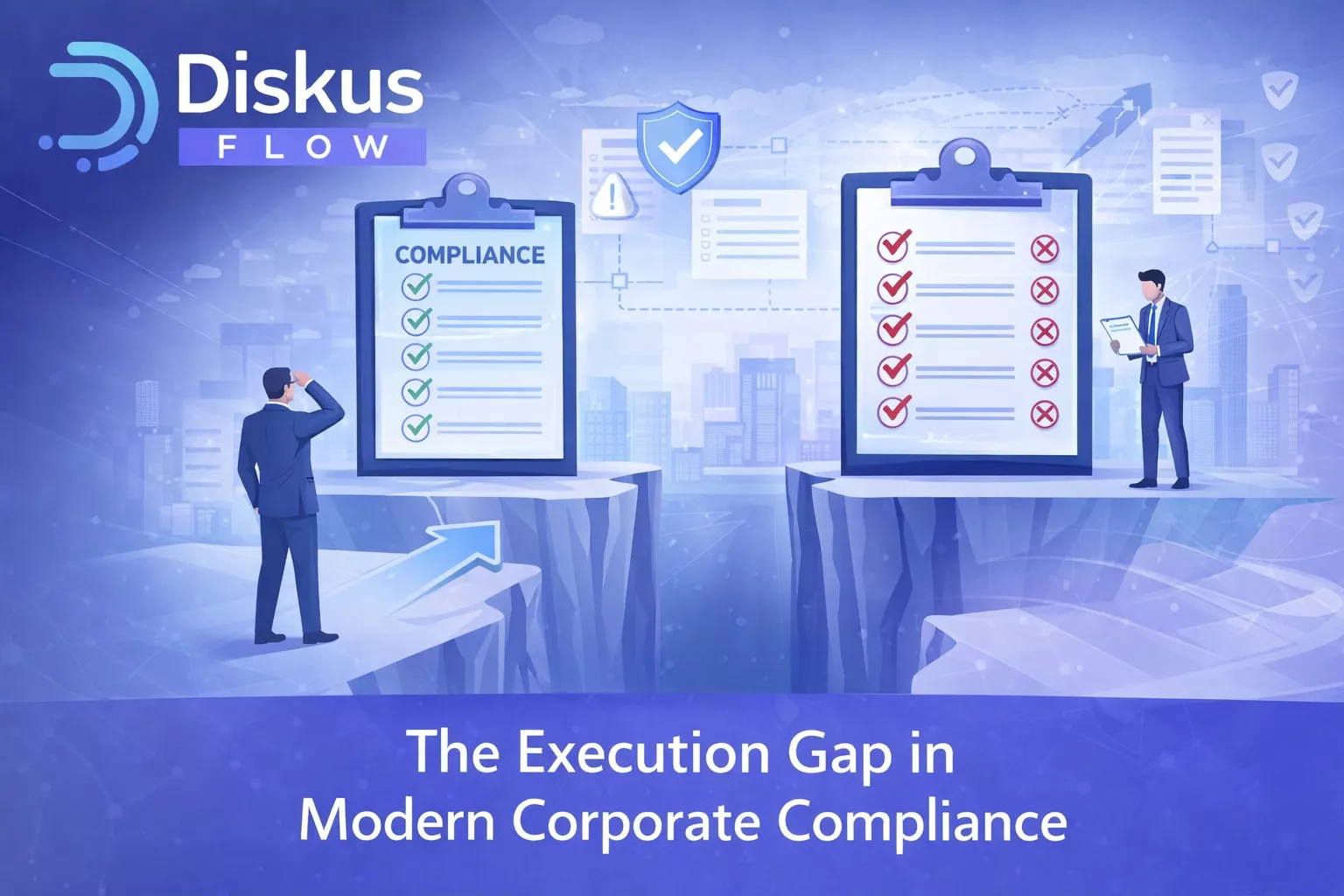
Corporate compliance has never been more documented, more structured, or more regulated than it is today. Yet despite this progress, organisations across industries continue to face enforcement actions, audit failures, and operational risk exposure.
This contradiction reflects a deeper organisational reality: modern compliance challenges are not primarily regulatory problems. They are execution problems.
The gap between what organisations intend to comply with and what they actually execute has become one of the defining governance challenges of the digital enterprise.
Compliance complexity is outpacing organisational execution
Over the past decade, regulatory environments have expanded significantly. Companies must now manage overlapping obligations related to data protection, financial conduct, cybersecurity, environmental governance, and operational resilience.
While policy frameworks have evolved to address these expectations, execution capacity has not always kept pace. Compliance teams often find themselves navigating fragmented processes, unclear ownership structures, and inconsistent monitoring mechanisms.
This growing imbalance between regulatory demand and operational capability is what creates the execution gap.
The shift from episodic compliance to operational continuity
Historically, compliance activities were concentrated around specific events: audits, regulatory submissions, or internal reviews. Today, regulatory expectations are shifting toward continuous oversight.
Organisations are increasingly required to demonstrate that compliance controls are functioning consistently, not just at predefined checkpoints. This evolution is driving demand for structured execution infrastructures such as continuous compliance software, which enables organisations to monitor governance activities as ongoing operational processes rather than periodic obligations.
Continuous compliance models fundamentally change how organisations think about governance. Instead of asking whether compliance was achieved at a specific moment, leadership must now ensure that compliance is maintained at all times.
The fragmentation of responsibility in large enterprises
In complex organisations, compliance responsibilities are distributed across multiple functions, including legal, risk, IT, finance, and operations. While this distribution reflects the interdisciplinary nature of governance, it also introduces execution challenges.
When compliance ownership is fragmented:
- Tasks may be duplicated or overlooked
- Accountability becomes difficult to trace
- Risk signals are delayed or diluted
- Evidence management becomes inconsistent
These structural issues often remain invisible until a regulatory review or audit exposes them. Addressing the execution gap, therefore, requires more than policy alignment; it requires operational coordination mechanisms.
Why compliance execution fails silently
One of the most significant risks in modern governance is that execution failures often develop gradually and remain undetected until they reach a critical threshold.
Unlike financial losses, compliance breakdowns do not always produce an immediate visible impact. Instead, they accumulate through missed tasks, delayed reviews, and incomplete documentation.
This silent progression makes execution risk particularly dangerous. Organisations may believe they are compliant simply because policies exist, even when underlying control activities are not being consistently performed.
To mitigate this risk, enterprises are increasingly exploring structured governance infrastructures such as regulatory compliance management software, which helps ensure that compliance activities are assigned, tracked, and validated systematically.
Technology is redefining compliance execution models
The evolution of enterprise technology is reshaping how governance functions operate. Digital platforms now enable organisations to integrate compliance workflows into operational systems, reducing reliance on manual coordination.
Execution-focused governance technology provides:
- Real-time visibility into compliance task completion
- Centralised documentation of control evidence
- Automated escalation of overdue responsibilities
- Improved coordination across departments
These capabilities support a transition from reactive compliance management to proactive governance execution.
The strategic consequences of execution gaps
The execution gap has implications that extend beyond regulatory enforcement. It affects organisational credibility, investor confidence, and operational stability. In highly regulated industries, governance reliability can influence market positioning and partnership opportunities.
As stakeholders demand greater transparency and accountability, organisations must demonstrate not only regulatory awareness but also execution competence. This shift is redefining how compliance performance is evaluated at the executive and board level.
The emergence of execution-driven governance thinking
Forward-looking organisations are beginning to treat compliance as an operational capability rather than a regulatory obligation. This perspective recognises that governance effectiveness depends on structured execution mechanisms embedded within daily workflows.
Within this evolving governance paradigm, platforms such as DiskusFlow reflect a broader industry movement toward execution-driven compliance models that emphasise accountability, coordination, and continuous assurance.
Closing the execution gap
Addressing the execution gap requires a combination of organisational change, process redesign, and technological integration. Leadership must prioritise execution visibility, clarify ownership structures, and adopt systems that support continuous compliance performance.
As regulatory landscapes continue to evolve, organisations that successfully close the execution gap will be better positioned to manage risk, maintain stakeholder trust, and achieve sustainable governance maturity.
Share this article on


