

Most organizations do not wake up one morning and suddenly face a major compliance issue. Regulatory observations, audit findings, control failures, and governance concerns rarely appear overnight. In most cases, they begin as small, seemingly insignificant issues that receive little attention at the time. A review is delayed. An action item remains open. Evidence is not uploaded. A policy update is postponed. A compliance certification misses its deadline. Individually, these issues may not appear serious. However, when left unresolved, they accumulate and gradually increase the organization's exposure to risk. What begins as a missed compliance task can eventually become a...

Most organizations do not wake up one morning and suddenly face a major compliance issue.
Regulatory observations, audit findings, control failures, and governance concerns rarely appear overnight. In most cases, they begin as small, seemingly insignificant issues that receive little attention at the time.
A review is delayed.
An action item remains open.
Evidence is not uploaded.
A policy update is postponed.
A compliance certification misses its deadline.
Individually, these issues may not appear serious. However, when left unresolved, they accumulate and gradually increase the organization’s exposure to risk.
What begins as a missed compliance task can eventually become a business problem.
The Compliance Risk Chain
One of the biggest misconceptions in compliance management is that compliance and business risk are separate issues.
In reality, they are closely connected.
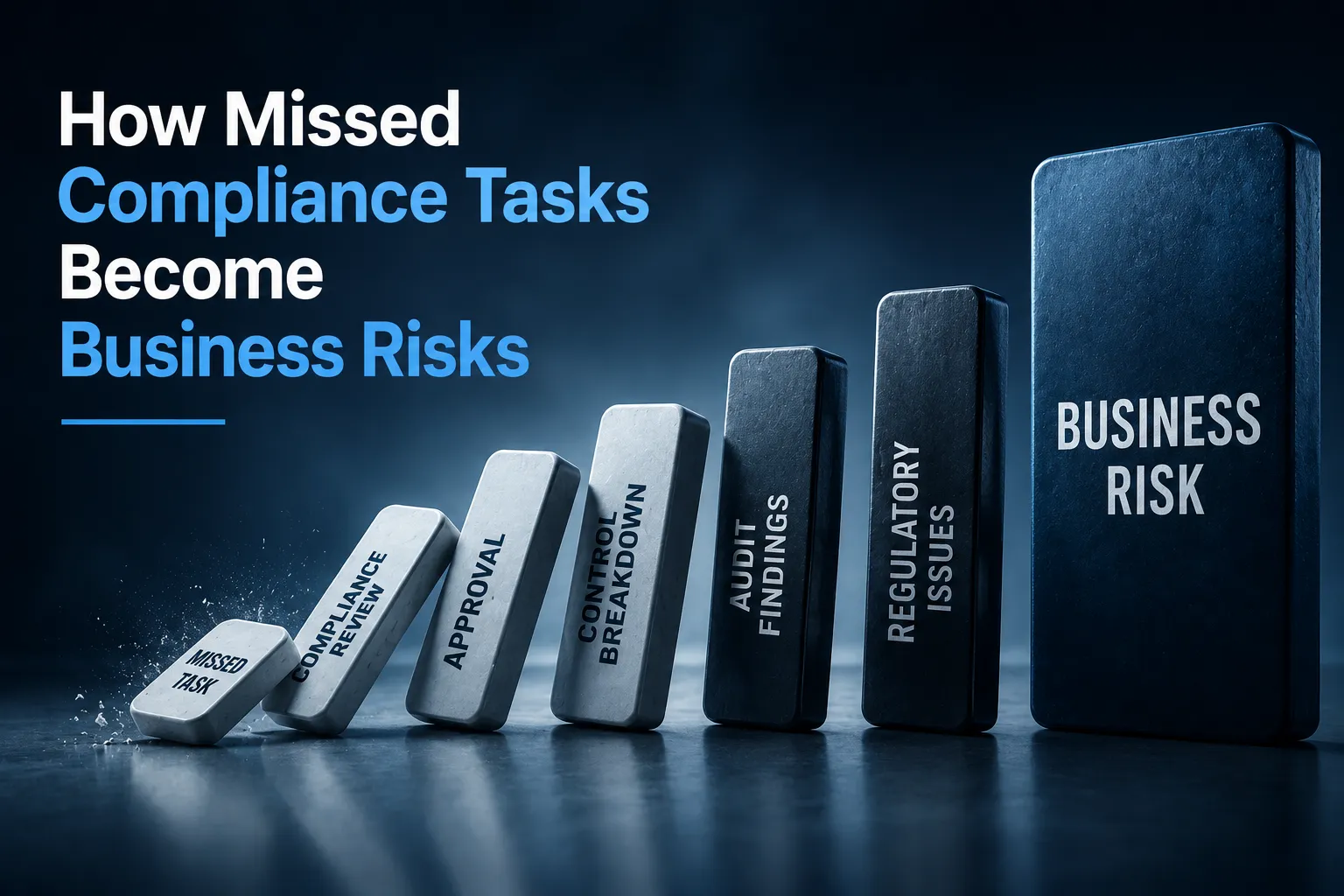
A useful way to understand this relationship is through what we call the Compliance Risk Chain.
Missed Task → Delayed Activity → Control Weakness → Audit Finding → Business Risk
The process often starts with a single overdue obligation. If the issue remains unresolved, controls become less effective, visibility declines, and risk exposure increases.
By the time leadership becomes aware of the problem, the original missed task may be long forgotten.
Why Small Compliance Failures Matter
Organizations often focus on major incidents while overlooking small execution failures.
This approach creates blind spots.
- A missed vendor review may increase third-party risk.
- An incomplete control assessment may hide operational weaknesses.
- Missing evidence may create audit challenges.
- A delayed remediation plan may allow known risks to remain unresolved.
None of these issues appear significant initially. Their impact becomes visible only when they accumulate.
This is why strong compliance programs focus on execution as much as documentation.
The Three Warning Signs
Organizations that struggle with compliance execution usually display three common warning signs.
Growing Lists of Open Actions
Compliance activities continue to increase while closure rates decline. Teams become busy managing tasks rather than completing them.
Excessive Dependence on Follow-Ups
Compliance teams spend significant time sending reminders and chasing updates. Progress depends on manual intervention rather than structured processes.
Repeated Audit Findings
The same issues continue appearing because corrective actions are not tracked effectively from assignment through completion.
These warning signs often indicate deeper execution weaknesses.
Why Compliance Execution Is Becoming a Leadership Priority
Historically, compliance was viewed as a regulatory requirement.
Today, it is increasingly viewed as a business discipline.
Leadership teams recognize that unresolved compliance activities can create financial, operational, reputational, and regulatory consequences.
As a result, organizations are focusing more attention on accountability, visibility, and execution.
The objective is not simply to comply with regulations.
The objective is to ensure compliance activities are completed consistently and on time.
From Task Management to Risk Management
Every compliance task exists for a reason.
A review, assessment, certification, or control activity is designed to reduce risk.
When these activities are missed, risk increases.
This is why organizations should not view compliance tasks as administrative requirements. They should view them as risk management activities.
The ability to track obligations, monitor progress, and identify overdue actions is becoming a critical component of effective governance.
How Technology Helps Reduce Compliance Risk
As organizations grow, manually tracking compliance activities becomes increasingly difficult.
Spreadsheets, emails, and shared folders often provide limited visibility into ownership and progress.
Modern Regulatory Compliance Software helps organizations create structure around compliance execution by providing:
- Clear ownership
- Task tracking
- Automated reminders
- Progress monitoring
- Audit trails
- Executive visibility
This helps organizations identify issues before they become larger business risks.
How DiskusFlow Helps
DiskusFlow helps organizations manage compliance obligations through structured workflows, accountability, and visibility.
As a Regulatory Compliance Software and Compliance Execution Software platform, DiskusFlow enables organizations to track tasks, assign ownership, monitor progress, and reduce execution gaps across departments.
This allows compliance teams to identify risks earlier and maintain stronger control over regulatory obligations.
Conclusion
Most business risks do not begin as business risks.
They begin as missed tasks, delayed actions, incomplete reviews, and unresolved compliance activities.
Organizations that can identify and address these issues early are far better positioned to reduce risk exposure, improve audit outcomes, and strengthen governance performance.
Because in compliance, small execution failures often become tomorrow’s biggest business risks.
Share this article on


