

Walk into almost any large organization and you will find shelves full of policies, procedures, governance frameworks, regulatory guidelines, risk registers, audit reports, and compliance manuals. Most organizations have invested considerable time, effort, and resources into documenting what employees should do, how controls should operate, and how risks should be managed. Yet despite this investment, compliance failures remain common. Regulatory deadlines are missed. Internal audits identify recurring findings. Evidence cannot be located when needed. Corrective actions remain incomplete. Risk issues stay unresolved for months. The organization appears compliant on paper but struggles to demonstrate that compliance obligations are actually being...

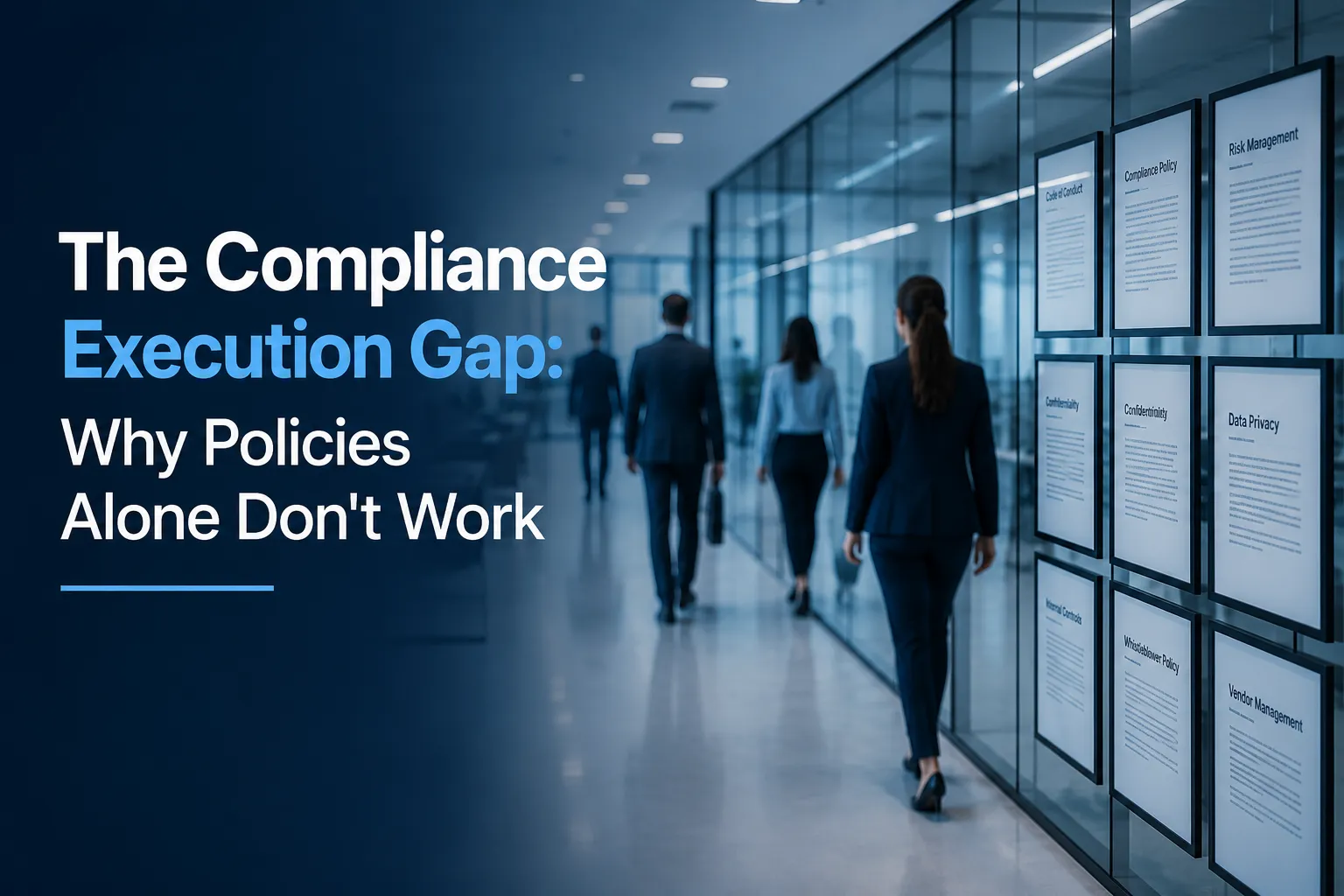
Walk into almost any large organization and you will find shelves full of policies, procedures, governance frameworks, regulatory guidelines, risk registers, audit reports, and compliance manuals. Most organizations have invested considerable time, effort, and resources into documenting what employees should do, how controls should operate, and how risks should be managed.
Yet despite this investment, compliance failures remain common.
Regulatory deadlines are missed. Internal audits identify recurring findings. Evidence cannot be located when needed. Corrective actions remain incomplete. Risk issues stay unresolved for months. The organization appears compliant on paper but struggles to demonstrate that compliance obligations are actually being executed consistently.
This is not a policy problem.
It is an execution problem.
The gap between what organizations intend to do and what actually gets done is one of the most significant governance challenges facing modern enterprises. This challenge is what we refer to as the Compliance Execution Gap.
Understanding and closing this gap is becoming increasingly important as regulatory expectations continue to rise and organizations face growing pressure to demonstrate not just compliance documentation, but compliance performance.
The Dangerous Assumption Behind Most Compliance Programs
Many compliance programs are built on a fundamental assumption.
The assumption is that once policies are written, communicated, and acknowledged, employees will naturally follow them.
Unfortunately, organizational reality is rarely that simple.
Policies define expectations. They explain responsibilities, establish controls, and provide guidance. However, policies do not assign tasks, monitor completion, collect evidence, escalate delays, or provide leadership visibility into execution performance.
A policy can clearly state that quarterly reviews must be conducted.
It cannot ensure those reviews actually happen.
A policy can require vendor risk assessments.
It cannot ensure someone completes them on time.
A policy can mandate cybersecurity controls.
It cannot verify that control testing was performed and documented correctly.
This distinction is critical because regulators, auditors, boards, and stakeholders increasingly evaluate organizations based on execution rather than documentation.
Having a policy is no longer enough.
Organizations must prove that policies are actively operating within day-to-day business activities.
Introducing the Compliance Execution Pyramid
One of the simplest ways to understand why compliance programs fail is through what we call the Compliance Execution Pyramid.
Many organizations focus almost entirely on the foundation of the pyramid while neglecting the layers above it.
Level 1: Policies
This is where most compliance programs begin.
Organizations create policies, procedures, standards, and governance frameworks. These documents define expectations and provide structure.
Policies are essential.
However, they are only the starting point.
Level 2: Ownership
Every compliance obligation requires a clearly accountable owner.
This is where many organizations begin to struggle.
A policy may state that a review must occur, but who is responsible for completing it?
When ownership becomes unclear, execution immediately becomes inconsistent.
Level 3: Tasks
Policies must be translated into specific actions.
Organizations often know what should happen but fail to convert requirements into structured, trackable tasks.
Without task management, compliance becomes dependent on memory, emails, and manual follow-ups.
Level 4: Evidence
Even when tasks are completed, organizations frequently struggle to maintain supporting evidence.
This creates significant challenges during audits and regulatory reviews.
If evidence cannot be produced, organizations may find it difficult to demonstrate compliance regardless of whether activities actually occurred.
Level 5: Visibility
The highest level of compliance maturity is visibility.
Leadership teams need real-time insight into compliance performance.
They need to know:
- Which obligations are overdue
- Which departments are behind schedule
- Which risks require attention
- Which controls have not been tested
Without visibility, governance becomes reactive rather than proactive.
The reality is that most organizations are reasonably strong at Level 1 and increasingly weak as they move upward through the pyramid.
This is where the Compliance Execution Gap emerges.
Why Organizations Fail at Levels Two and Three
Most compliance failures can be traced back to weaknesses in ownership and task execution.
These failures are rarely intentional.
They usually develop through normal operational pressures.
Employees have competing priorities.
Managers focus on business objectives.
Departments operate independently.
Responsibilities become fragmented.
Over time, compliance activities become disconnected from accountability.
The result is a growing gap between documented requirements and operational execution.
This explains why organizations can possess mature governance frameworks while simultaneously experiencing recurring compliance failures.
The Four Warning Signs of a Compliance Execution Gap
Organizations experiencing execution challenges typically display several common warning signs.
Compliance Is Managed Through Email
Email is often the first indicator.
Teams rely on reminders, follow-ups, and lengthy email chains to coordinate compliance activities.
While email may facilitate communication, it does not provide accountability, visibility, or execution tracking.
Compliance Lives in Spreadsheets
Many organizations attempt to manage compliance through spreadsheets.
While spreadsheets are useful for storing information, they were never designed to manage execution.
As compliance complexity increases, spreadsheets become increasingly difficult to maintain and monitor.
Audit Preparation Becomes a Fire Drill
Organizations experiencing execution gaps often spend weeks preparing for audits.
Evidence must be collected.
Tasks must be verified.
Documentation must be reconstructed.
This usually indicates that compliance activities are not being tracked continuously.
Leadership Lacks Visibility
Perhaps the most serious warning sign is limited executive visibility.
When leadership cannot easily answer questions about compliance performance, risk exposure, or overdue obligations, execution weaknesses often exist beneath the surface.
Why Regulatory Expectations Are Changing
Historically, regulators focused heavily on documentation.
Organizations were expected to demonstrate that policies existed and controls had been designed appropriately.
Today, regulatory expectations have evolved.
Increasingly, regulators want evidence of execution.
They want organizations to demonstrate:
- Ongoing compliance monitoring
- Accountability structures
- Control effectiveness
- Continuous oversight
- Audit readiness
This shift is forcing organizations to rethink how compliance programs operate.
Documentation remains important.
Execution has become critical.
From Compliance Management to Compliance Execution
For many years, compliance management focused on maintaining policies and responding to audits.
Today, leading organizations are adopting a different approach.
They are focusing on compliance execution.
This means treating compliance as an operational discipline rather than an administrative activity.
Instead of asking:
“Do we have a policy?”
They ask:
“Can we prove the policy is being executed?”
This subtle change in mindset produces dramatically different outcomes.
Execution-focused organizations prioritize accountability, monitoring, workflow management, evidence collection, and visibility.
As a result, they tend to perform better during audits, respond faster to regulatory changes, and maintain stronger governance performance.
The Role of Compliance Execution Software
Closing the Compliance Execution Gap requires more than additional policies.
It requires systems capable of operationalizing compliance.
This is where Compliance Execution Software plays a critical role.
Rather than functioning as a document repository, modern Compliance Execution Platforms help organizations convert compliance obligations into structured workflows.
Responsibilities can be assigned
Tasks can be tracked
Evidence can be collected
Progress can be monitored
Leadership can gain visibility
The result is a compliance program that operates continuously rather than periodically.
Organizations move away from reactive compliance management and toward proactive compliance execution.
Why the Future Belongs to Execution-Focused Organizations
The organizations that will succeed in the coming decade are not necessarily those with the largest policy libraries.
They will be the organizations that execute most effectively.
As regulations continue to expand, governance complexity will increase.
The volume of compliance obligations will grow.
The need for accountability will become more important.
Organizations that build strong execution capabilities today will be better positioned to manage future regulatory challenges.
They will spend less time chasing evidence.
Less time responding to audit findings.
Less time managing compliance through spreadsheets and emails.
And more time focusing on strategic growth.
How DiskusFlow Helps Close the Compliance Execution Gap
DiskusFlow was built around a simple observation.
Most organizations already know what they need to do.
The challenge is ensuring it gets done.
As a Compliance Execution Software and Compliance Execution Platform, DiskusFlow helps organizations operationalize governance by converting compliance obligations into structured workflows with clear ownership, task tracking, evidence management, accountability, and executive visibility.
Instead of relying on fragmented processes, organizations can create a single compliance operating environment that supports continuous execution and continuous compliance.
Frequently Asked Questions
What is the Compliance Execution Gap?
The Compliance Execution Gap is the difference between documented compliance requirements and the actual execution of those requirements within daily operations.
Why do policies alone fail to ensure compliance?
Policies define expectations but do not assign tasks, monitor completion, maintain evidence, or provide visibility into execution performance.
What is Compliance Execution Software?
Compliance Execution Software helps organizations manage compliance activities through structured workflows, accountability mechanisms, monitoring, and evidence management.
How can organizations close the Compliance Execution Gap?
Organizations can close the gap by strengthening ownership, improving task management, maintaining evidence continuously, increasing visibility, and implementing execution-focused compliance systems.
Conclusion
Most organizations do not suffer from a lack of policies.
They suffer from a lack of execution.
The Compliance Execution Gap exists because compliance activities often fail at the points where ownership, task management, evidence collection, and visibility intersect. Policies may define expectations, but execution determines outcomes.
Organizations that recognize this distinction are increasingly shifting their focus from compliance documentation to compliance execution. They understand that governance maturity is no longer measured by the number of policies written, but by the consistency with which those policies are carried out across the organization.
In the years ahead, the strongest compliance programs will not be built on documentation alone. They will be built on accountability, visibility, and execution.
Share this article on


