

For years, compliance teams have relied on two familiar tools to manage regulatory obligations, audit activities, policy reviews, and governance tasks. Email and spreadsheets. At first glance, they appear sufficient. Emails can be used to assign tasks, send reminders, and collect responses. Spreadsheets can be used to track deadlines, maintain records, and monitor progress. For smaller organizations with limited compliance obligations, these tools may work reasonably well. However, as organizations grow and regulatory requirements become more complex, these tools begin to reveal serious limitations. Tasks get missed. Deadlines slip. Evidence becomes difficult to locate. Ownership becomes unclear. Audit preparation becomes...

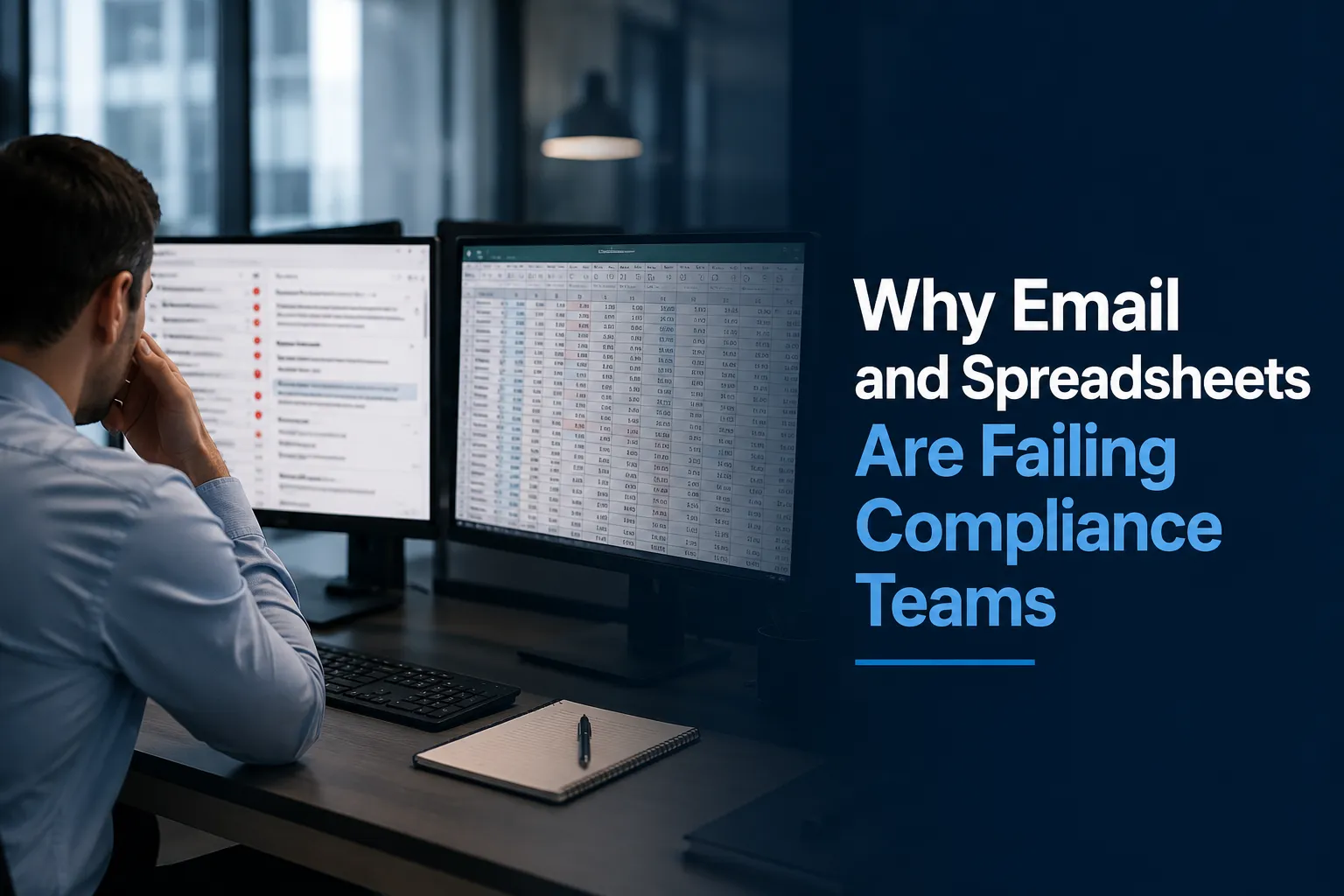
For years, compliance teams have relied on two familiar tools to manage regulatory obligations, audit activities, policy reviews, and governance tasks.
Email and spreadsheets.
At first glance, they appear sufficient.
Emails can be used to assign tasks, send reminders, and collect responses. Spreadsheets can be used to track deadlines, maintain records, and monitor progress.
For smaller organizations with limited compliance obligations, these tools may work reasonably well.
However, as organizations grow and regulatory requirements become more complex, these tools begin to reveal serious limitations.
Tasks get missed.
Deadlines slip.
Evidence becomes difficult to locate.
Ownership becomes unclear.
Audit preparation becomes stressful.
Visibility disappears.
The reality is that email and spreadsheets were never designed to manage compliance execution at scale.
Modern compliance environments require a more structured approach.
This is why organizations are increasingly adopting Compliance Workflow Automation Software to replace fragmented manual processes with centralized, accountable, and trackable compliance workflows.
The Compliance Complexity Problem
Compliance today is fundamentally different from compliance ten years ago.
Organizations must now manage a growing number of obligations related to:
- Data privacy regulations
- Cybersecurity requirements
- ESG reporting frameworks
- Operational resilience standards
- Financial controls
- Internal governance policies
- Third-party risk management
- Industry-specific regulations
Every requirement generates actions.
Someone must complete a review.
Someone must approve a document.
Someone must provide evidence.
Someone must verify completion.
Someone must monitor progress.
The challenge is not understanding what needs to be done.
The challenge is ensuring that every task gets completed correctly and on time.
As compliance obligations multiply, email and spreadsheets become increasingly difficult to manage.
Why Email Creates Compliance Risks
Email is designed for communication.
It is not designed for execution management.
Yet many organizations still depend heavily on email to coordinate compliance activities.
This creates several problems.
Important Tasks Get Buried
Compliance reminders often compete with hundreds of daily emails.
A task that seemed urgent when sent may be forgotten within hours.
Employees change priorities.
Messages get overlooked.
Deadlines approach unnoticed.
When compliance relies on inbox management, consistency becomes difficult to maintain.
No Central Visibility
A compliance manager may send dozens of emails requesting updates.
Responses arrive from different departments at different times.
Some responses are missed.
Some are incomplete.
Others remain buried in lengthy email threads.
As a result, no one has a complete view of compliance execution.
Leadership often has no reliable way of knowing:
- Which tasks are complete
- Which tasks are overdue
- Which departments are behind schedule
- Which obligations present the highest risk
Accountability Is Weak
Email does not provide structured ownership.
A message can be copied to ten people.
Everyone receives it.
Nobody owns it.
This creates one of the most common causes of compliance failure: unclear accountability.
The Spreadsheet Problem
Spreadsheets are often viewed as a compliance team’s best friend.
They are flexible, inexpensive, and familiar.
Unfortunately, they create significant limitations as compliance programs mature.
Manual Updates Create Errors
Spreadsheets depend on human discipline.
Someone must update status fields.
Someone must record completion dates.
Someone must track overdue activities.
Someone must maintain version control.
The more manual the process becomes, the greater the likelihood of errors.
No Automated Escalation
One of the biggest weaknesses of spreadsheets is the inability to escalate issues automatically.
When deadlines are missed:
- No alerts are triggered
- No escalation occurs
- No accountability mechanism exists
As a result, overdue compliance activities often remain unnoticed until audit season.
Limited Collaboration
Compliance activities rarely involve a single individual.
Most obligations require collaboration between multiple departments.
Spreadsheets struggle to support:
- Multi-step approvals
- Workflow routing
- Automated notifications
- Evidence collection
- Task ownership tracking
Organizations often find themselves building increasingly complicated spreadsheets in an attempt to solve problems that spreadsheets were never designed to address.
The Hidden Costs of Manual Compliance Management
The direct costs of email and spreadsheets may appear low.
The indirect costs are much higher.
Lost Productivity
Compliance teams spend considerable time:
- Sending reminders
- Following up on overdue actions
- Collecting updates
- Consolidating reports
- Preparing audit evidence
Instead of focusing on risk management and governance improvement, they spend their time coordinating administrative activities.
Increased Audit Pressure
When compliance evidence is scattered across emails, folders, and spreadsheets, preparing for audits becomes difficult.
Teams often spend weeks gathering information that should already be available.
This creates stress, delays, and unnecessary workload.
Higher Compliance Risk
Missed tasks and incomplete documentation increase the likelihood of:
- Audit findings
- Regulatory observations
- Control failures
- Governance weaknesses
The cost of these issues often exceeds the cost of implementing a structured compliance solution.
What Modern Compliance Teams Need
Today’s compliance environment requires more than task lists and email reminders.
Organizations need systems that support execution.
A modern Compliance Workflow Management System should provide:
Clear Ownership
Every compliance activity should have a designated owner.
Responsibilities should be visible and measurable.
Workflow Automation
Tasks should move through predefined approval and review processes automatically.
Evidence Management
Supporting documentation should be collected and stored alongside compliance activities.
Escalation Controls
Overdue actions should trigger notifications and escalation workflows.
Executive Visibility
Leadership should have access to real-time dashboards showing compliance performance across the organization.
The Rise of Compliance Workflow Automation
Organizations are increasingly adopting Regulatory Workflow Automation to solve these challenges.
Workflow automation transforms compliance from a manual process into a structured operational capability.
Instead of relying on memory and follow-up emails, organizations can:
- Assign tasks automatically
- Route approvals efficiently
- Track completion status
- Escalate delays
- Maintain audit trails
- Generate compliance reports
This creates consistency, transparency, and accountability.
More importantly, it reduces the risk of critical compliance obligations being overlooked.
How Workflow Automation Improves Accountability
Accountability is one of the most important drivers of compliance success.
Without accountability, even the best policies fail.
Compliance Workflow Automation Software strengthens accountability by:
Making Ownership Visible
Everyone knows who is responsible for each activity.
Tracking Completion
Progress can be monitored continuously.
Measuring Performance
Organizations can evaluate execution effectiveness across departments.
Creating Audit Trails
Every action is documented automatically.
These capabilities significantly improve governance maturity and compliance performance.
The Shift Toward Compliance Execution
Historically, organizations focused heavily on compliance documentation.
Today, they are focusing on compliance execution.
This shift reflects a growing realization:
Compliance failures rarely occur because policies are missing.
They occur because required actions are not completed.
Execution-focused organizations therefore prioritize:
- Task management
- Workflow automation
- Accountability
- Monitoring
- Evidence collection
This is where Compliance Execution Software plays a critical role.
How DiskusFlow Helps Organizations Move Beyond Email and Spreadsheets
DiskusFlow was built to address the execution challenges that email and spreadsheets cannot solve.
As a Compliance Workflow Automation Software and Compliance Operations Platform, DiskusFlow enables organizations to manage compliance activities through structured workflows.
Instead of relying on disconnected emails and manually maintained spreadsheets, teams can:
- Assign ownership clearly
- Track compliance obligations
- Automate approvals
- Monitor progress in real time
- Escalate overdue activities
- Maintain audit-ready evidence
The result is stronger accountability, improved visibility, and more consistent compliance execution.
Frequently Asked Questions
Why are spreadsheets not suitable for compliance management?
Spreadsheets lack workflow automation, escalation capabilities, audit trails, accountability tracking, and real-time visibility, making them difficult to manage as compliance programs grow.
What is Compliance Workflow Automation Software?
Compliance Workflow Automation Software helps organizations automate compliance tasks, approvals, reviews, reminders, and evidence collection while improving accountability and visibility.
How does workflow automation improve compliance?
Workflow automation reduces manual effort, strengthens accountability, improves execution consistency, and helps organizations maintain audit readiness.
What is Regulatory Workflow Automation?
Regulatory Workflow Automation refers to using technology to manage regulatory obligations through structured workflows, ensuring tasks are completed and monitored efficiently.
Key Takeaways
- Email and spreadsheets were not designed to manage compliance execution at scale.
- Manual processes create visibility gaps, accountability issues, and audit challenges.
- Compliance complexity continues to increase across industries.
- Workflow automation helps organizations improve consistency and reduce risk.
- Accountability and visibility are critical to compliance success.
- Compliance execution is becoming more important than compliance documentation.
Conclusion
Email and spreadsheets have served compliance teams for many years.
However, modern regulatory environments demand more than manual coordination.
Organizations need systems that can manage ownership, automate workflows, track progress, collect evidence, and provide leadership visibility.
As compliance obligations continue to expand, workflow automation is no longer a convenience.
It is becoming a necessity.
Organizations that move beyond email and spreadsheets will be better positioned to maintain compliance, strengthen governance, and remain audit ready in an increasingly complex regulatory landscape.
Share this article on


